
Research
Game enrichment agent
Public game sources become a structured research record after required-field and completeness checks.
Proof in production
StreamGist helps streamers pick games to play and turns their choices into a demand read for game studios, live in production.
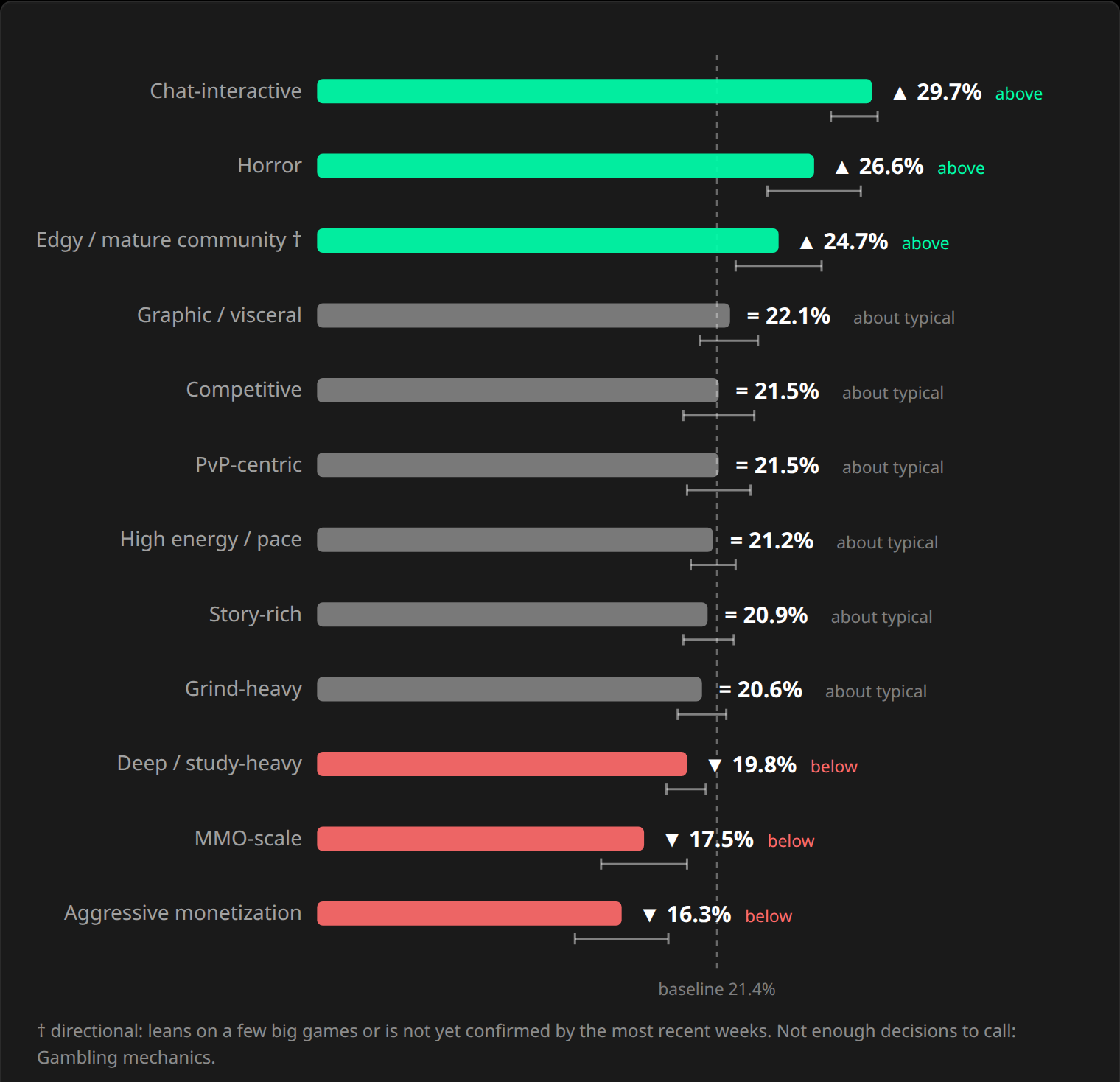
Demand read
Streamers save or skip each recommendation. In aggregate, those choices show game studios which qualities pull saves, measured against a baseline with confidence ranges. It is a demand read, not a forecast.
Read the demand reportOpen the live productWhy it matters
Early on I directed contract engineers, designers, and SEO help. Now I run the company alone: agents do research, monitoring, and engineering, a second model reviews every change, and I approve it.
The customer-facing core is plain, testable code, so a model failure can't take down the product.
Representative agents
Three of the agents that run StreamGist. Each has defined inputs, code-enforced controls, and reviewable outputs.
Public game sources become a structured research record after required-field and completeness checks.
User choices and stream results are checked against preset quality and alert rules to produce a daily quality read.
Daily checks on infrastructure, product health, and revenue. AI writes the briefing, and a person decides what to act on.
Public documentation
Two public pages go deeper.
See how recurring signals become reviewable decisions, who owns the call, and what happens afterward.
See the operating modelSee where StreamGist uses AI, where ordinary code takes over, and what keeps working when a model doesn't.
See the recommendation architectureStreamGist is how I know the method holds. I bring the same controls to client work.